







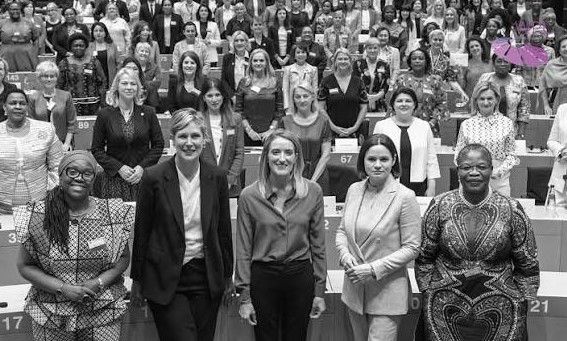


In 1995, the world’s governments gathered in Beijing for a landmark conference on women’s rights, and one of the starkest facts on the table was how few women held political power. At that point, women occupied barely one in nine seats in the world’s parliaments. Three decades later, that share has more than doubled. It is one of the clearest measures of women’s advancing status — and, at the same time, one of the clearest illustrations of how slow, uneven and reversible such progress can be.
The three-decade arc, in numbers
The authoritative source for this data is the Inter-Parliamentary Union (IPU), the global organisation of national parliaments, which has tracked women’s representation for decades. Its 2025 report Women in Parliament: 1995–2025, marking thirty years since Beijing, provides the definitive figures.
In 1995, women held 11.3% of parliamentary seats worldwide (in single or lower houses). By 2025, that figure had reached 27.2% — a gain of nearly 16 percentage points, or roughly a 2.5-fold increase, over three decades. (The commonly cited “10% to 27%” is a rounding of these precise numbers.)
This is genuine structural change. In 1995, not a single parliament in the world had achieved gender parity. By 2025, six had reached parity or a female majority: Rwanda, Cuba, Nicaragua, Mexico, Andorra and the United Arab Emirates. Rwanda remains the global leader by a wide margin, with women holding around 61% of the seats in its lower house — the only country to have sustained a female parliamentary majority for more than a decade.
The engine of change: quotas
If one factor explains most of this progress, it is the deliberate use of gender quotas. The IPU’s data make the effect impossible to miss: in 2024, countries that applied some form of electoral gender quota elected 31.2% women on average, while countries with no quotas elected just 16.8% — a gap of more than fourteen percentage points. Quotas come in several forms: constitutional or legislated reserved seats, legal candidate quotas requiring parties to field a minimum share of women, and voluntary party quotas. Whatever the mechanism, the pattern is consistent — countries that engineer women’s inclusion get far more of it than those that wait for it to happen organically.


Rwanda is the clearest case. Its post-genocide constitution of 2003 reserved a substantial share of parliamentary seats for women, and the country built on that floor to become the world’s most gender-balanced legislature. The lesson is not that Rwandan society was uniquely primed for women’s leadership, but that a deliberate institutional design produced an outcome that no amount of waiting would have.
An uneven map
The global average conceals enormous regional variation. As of 2025, the Americas led all regions, with women holding 35.4% of parliamentary seats — a rise of nearly 23 points since 1995, the fastest of any region. Europe and Sub-Saharan Africa followed in the mid-to-high twenties. Asia brought up the rear, with growth of less than nine percentage points over the entire thirty-year period — a reminder that progress in one part of the world does not automatically diffuse to others.
These regional differences reflect a mix of factors: the adoption or rejection of quotas, the design of electoral systems (proportional-representation systems tend to elect more women than winner-take-all systems), cultural norms, and the strength of women’s movements pressing for inclusion.
Progress has stalled — and can reverse
Perhaps the most sobering finding of the IPU’s 2025 report is that momentum has faltered. In 2024, despite 73 parliamentary chambers holding elections or renewals, women’s global share rose by only 0.3 percentage points — the slowest rate of increase since 2017. After years of steady gains, the trend line is flattening.
This matters because it punctures a comfortable assumption: that women’s representation will keep rising automatically until it reaches parity. It will not. Gains have been driven by active choices — quota laws, party commitments, sustained advocacy — and where those choices are absent or rolled back, progress stops or reverses. The IPU itself does not publish a single official year-to-parity projection, but UN Women, extrapolating from recent rates, has warned that parity in national legislatures will not be reached for decades at the current pace — a timeline stretching well past the middle of this century.
Why representation matters beyond the numbers
The case for women in parliament is not merely about fairness of headcount. A substantial research literature, discussed elsewhere in this collection, shows that women in political office often change what governments do — shifting spending toward health, education, water and child welfare, and in some contexts reducing corruption. Representation is a means as well as an end: it alters whose priorities are heard when budgets are written and laws are passed.


There is also a powerful role-model effect. Studies from India and elsewhere have found that the mere presence of women in visible leadership raises the aspirations of girls and shifts public perceptions of what women can do. Each cohort of female legislators makes the next one more imaginable.
The unfinished journey
The arc from 11% to 27% over thirty years is a real achievement, worth stating plainly against those who claim nothing has changed. But 27% is still barely half of parity, the pace has slowed to a crawl, and the gains rest on institutional choices that can be undone. The next doubling — from a quarter of seats to half — will not happen on its own. It will require the same deliberate tools that produced the first: quotas, electoral reform, party commitment and relentless advocacy. ### The debate over quotas
Because quotas are so central to this story, the arguments around them deserve a fair hearing. Critics raise two main objections. The first is a concern about merit — the worry that quotas elevate candidates chosen for gender rather than competence. The second is symbolic — the fear that quota-elected women will be seen as tokens and taken less seriously, or confined to “women’s issues.”
The evidence has largely answered the first objection. Studies of quota systems, including detailed work on India’s panchayat reservations, generally find no drop in the competence or effectiveness of women brought in through quotas; in some analyses, quotas actually improve the average quality of the political class by displacing mediocre incumbents who held their seats through connections rather than ability. On the second objection, research on India found that repeated exposure to female leaders reduced bias against them over time — voters who had experienced a woman in charge were less likely to hold prejudiced views and more likely to elect women even after the quota was lifted. Quotas, in other words, can be self-liquidating: by normalising female leadership, they can eventually make themselves unnecessary. This does not mean quotas are costless or that every design works equally well, but the sweeping claim that they trade away merit for representation is not supported by the data.
Beyond parliament: the fuller picture of political power
Focusing on parliamentary seats, while it gives the clearest long-run trend line, understates how far women remain from the real levers of executive power. Women hold a considerably smaller share of the most powerful political positions — cabinet ministries, and especially the senior economic and security portfolios (finance, defence, foreign affairs) that carry the most weight — than they do of ordinary legislative seats. They are scarcer still as heads of government and heads of state: across all of recorded history, only a small number of countries have ever been led by a woman, and at any given moment the number of female presidents and prime ministers worldwide is a modest fraction of the total. Within legislatures, women are also often channelled toward committees dealing with social affairs, family and education, and away from finance and defence. So the 27% headline, encouraging as the trend is, describes the most accessible tier of political power; the higher and more consequential the office, the more male it remains — a pattern that exactly mirrors the corporate ladder described elsewhere in this collection.
Why the stall should worry everyone
The 2024 slowdown is not merely a statistical blip; it is a warning about the fragility of progress. Gains in women’s representation have coincided, in many places, with a broader expansion of democratic norms and a global consensus, however imperfect, in favour of gender equality. Where that consensus weakens — where democratic backsliding, the rollback of quotas, or organised opposition to gender equality take hold — women’s representation is among the first things to stall or reverse. History offers cautionary examples of hard-won women’s gains being wound back during periods of political reaction. The lesson of the IPU’s thirty-year dataset is not that progress is inevitable but that it is made — through specific laws, institutions and sustained pressure — and that what is made can also be unmade if the effort behind it lapses.
The role of electoral systems
One structural factor deserves particular emphasis because it is so often overlooked in favour of cultural explanations: the design of the electoral system itself has a large and well-documented effect on how many women get elected. Proportional-representation systems, in which parties present lists of candidates and win seats in proportion to their vote share, consistently elect more women than “first-past-the-post” majoritarian systems, in which a single candidate wins each district. The reason is straightforward. Under a list system, a party fields many candidates at once and faces visible pressure to present a balanced slate; leaving women off a long list is conspicuous, and quota rules requiring alternation of men and women on lists (“zippering”) are easy to apply. Under a winner-take-all system, each party picks a single candidate per district, and the safe, incumbent-favouring logic of that choice tends to reproduce the existing, male-dominated political class. This is why some of the countries with the highest women’s representation combine proportional systems with quotas, and why reforming the electoral system — not just exhorting parties to do better — is one of the more powerful available levers. It is a reminder that representation is shaped as much by institutional plumbing as by attitudes.
What women’s presence changes
The case for representation ultimately rests on the evidence, examined elsewhere in this collection, that women in office govern differently — but it is worth drawing the threads together here. Across varied settings, higher female representation has been associated with greater legislative attention to health, education, childcare, family policy and social welfare; with different budget priorities; and, under accountable institutions, with lower corruption. Women legislators are more likely to sponsor and champion legislation on issues that disproportionately affect women and children, issues that male-dominated bodies had historically neglected. None of this implies that women vote as a bloc or that any individual woman represents all women; legislatures contain women of every ideology. But in aggregate, the presence of a critical mass of women measurably widens the range of issues a parliament treats as its business. Representation, on this evidence, is not merely a matter of fairness in who holds office; it changes what governments actually do — which is the strongest possible argument for why the climb from a quarter of seats to half is worth the deliberate effort it will require.
There is, finally, a generational dimension that offers cautious hope against the recent stall. The women entering politics today came of age in societies where female leadership, while still rare at the top, is far more visible and normalised than it was for their mothers. Each cohort of female legislators, mayors and ministers expands the set of role models available to the next, and the research on role-model effects — girls raising their aspirations after seeing women lead — suggests this compounds over time. The stall of 2024 is real and should not be minimised, but it sits atop a thirty-year structural shift that has changed what a plausible political career looks like for a woman in most of the world. The task is to ensure that this rising generation of ambition meets institutions — quotas, fair electoral systems, supportive parties — designed to let it through, rather than the barriers that filtered out the generations before.
The lesson of the past three decades is that women’s political power grows when societies decide to build it, and stalls the moment they assume it will build itself.
Sources: Inter-Parliamentary Union, Women in Parliament: 1995–2025 (March 2025) and IPU Parline global and regional databases; UN Women, Women in Politics data.